
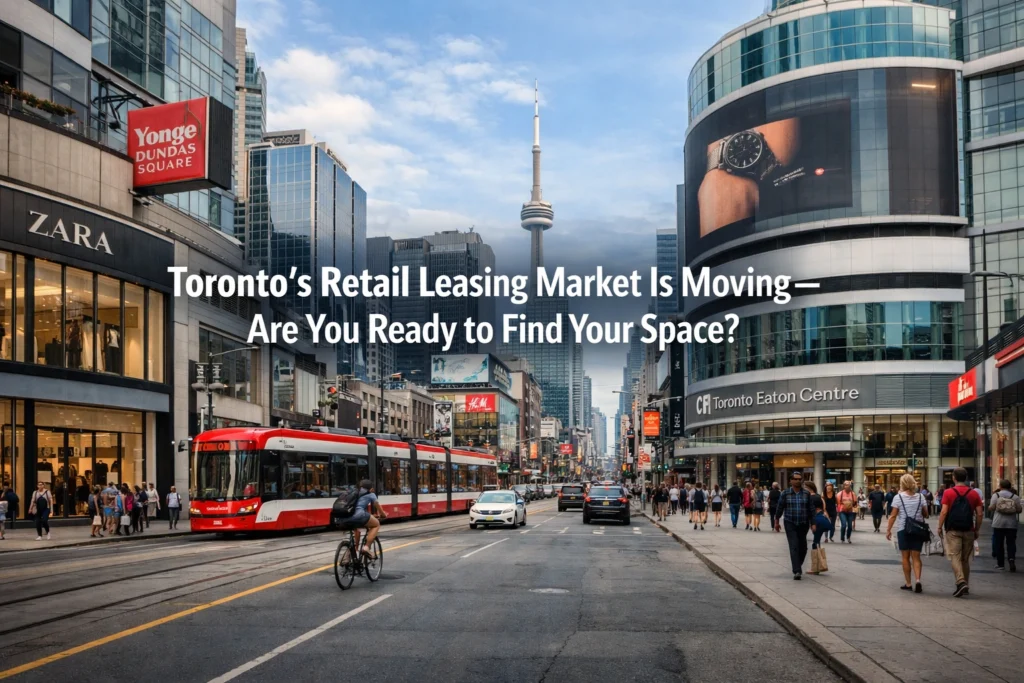
Toronto’s Retail Leasing Market Is Moving — Are You Ready to Find Your Space?
Retail real estate in Toronto is having a genuine moment. After years of uncertainty, neighbourhood retail, food-anchored properties, and experiential commercial spaces are seeing strong demand across the GTA. If you are a business owner searching for retail space for lease in Toronto, you are entering a competitive market — and preparation is everything.
This guide covers everything a retail tenant needs to know before signing a lease in Toronto, from evaluating a location’s foot traffic to understanding net lease structures and negotiating your fit-out contribution. You can also browse current retail space for lease in Toronto to see what is actively available.
What Is Driving Retail Leasing Demand in Toronto Right Now?
Several converging factors are fuelling retail leasing activity in the GTA in 2026. Consumer foot traffic has recovered strongly in neighbourhood commercial strips. Food and beverage concepts, health and wellness businesses, and service-based retailers are expanding aggressively. Meanwhile, the return-to-office trend is repopulating Toronto’s downtown core and inner suburbs, bringing daytime foot traffic back to commercial corridors.
At the same time, some national anchor tenants have vacated larger retail spaces, creating opportunities for independent retailers and regional concepts to secure high-visibility locations that were previously unavailable. This window will not stay open indefinitely.
How to Evaluate a Retail Location in Toronto
Foot Traffic and Visibility
For most retail businesses, location is the single most important variable. A well-negotiated lease in a high-traffic location will outperform a cheap lease in an invisible one. Study the pedestrian and vehicle traffic patterns at different times of day, different days of the week, and across seasons. What looks busy on a Tuesday afternoon may be dead on a Sunday morning.
Neighbouring Tenants and Trade Mix
The businesses surrounding your space directly affect your foot traffic. A complementary anchor tenant — a grocery store, pharmacy, or popular food and beverage brand — drives consistent traffic past your door. A vacant anchor space next door has the opposite effect. Understand the full tenant mix before committing.
Parking and Transit Access
Toronto is a city of neighbourhoods, and access patterns vary dramatically by area. In suburban corridors, parking availability is a critical retail driver. In dense urban areas, proximity to TTC subway and streetcar routes matters far more. Match your location selection to your target customer’s commuting behaviour.
Zoning and Permitted Uses
Not every commercial space in Toronto is zoned for every type of retail use. Food preparation businesses, licensed premises, childcare operations, and medical or wellness businesses all have specific zoning requirements. Confirm that the space is appropriately zoned for your intended use before investing in lease negotiations.
Allen Mayer’s team can help you assess zoning and permitted uses for any prospective location. Explore available commercial properties across Toronto, Mississauga, and Vaughan to compare your options across the GTA.
Understanding Your Retail Lease: Key Terms Explained
Base Rent and Total Occupancy Cost
The advertised base rent is rarely the full picture. In a net lease — the most common retail lease structure in Toronto — you will pay base rent plus your proportionate share of property taxes, building insurance, and common area maintenance costs. Always ask for the estimated total occupancy cost per square foot before comparing properties.
Percentage Rent Clause
Many shopping centre and high-street retail leases include a percentage rent clause, where you pay a percentage of your gross sales above a defined natural breakpoint. This aligns the landlord’s income with your success, but understand how the clause is structured before agreeing to it.
Exclusivity Clause — Non-Negotiable for Retailers
An exclusivity clause prevents the landlord from leasing any other unit in the property to a direct competitor. This is a standard protection in well-negotiated retail leases and should be clearly defined, specific to your business category, and binding on the landlord’s future tenants.
Signage Rights
Your right to exterior signage — including pylon signs, fascia signage, and blade signs — should be explicitly detailed in your lease. Do not assume signage rights are included. In multi-tenant properties, signage restrictions can significantly limit your visibility to passing traffic.
Co-Tenancy Clause
In shopping centre and anchor-dependent retail locations, a co-tenancy clause allows you to reduce your rent or terminate the lease if a key anchor tenant vacates. This is a critical protection for tenants whose business performance is tied to the traffic generated by a specific anchor.
📌 For a full breakdown of commercial lease negotiation tactics across all property types, read the Allen Mayer guide on commercial lease negotiation in Toronto.
Retail Space Costs Across Toronto’s Key Commercial Corridors
Retail rents vary dramatically across Toronto’s commercial corridors and suburban markets. High-street retail in areas like Bloor-Yorkville, Queen West, and King Street West commands premium rents, while neighborhood strips in Etobicoke, Scarborough, and North York offer more accessible entry points for emerging businesses.
If budget is a constraint, it is worth exploring retail opportunities in adjacent markets. Commercial real estate in Mississauga and Vaughan offer lower occupancy costs with strong consumer demographics, and both markets have seen significant population and spending growth in recent years.
Before You Sign: A Pre-Signing Checklist for Toronto Retail Tenants
- Confirm zoning permits your intended retail use.
- Request the estimated total occupancy cost including all net charges.
- Review the previous year’s audited operating cost statement.
- Negotiate a tenant improvement allowance for fit-out costs.
- Secure an exclusivity clause specific to your business category.
- Confirm signage rights in writing as part of the lease.
- Include a co-tenancy clause if your traffic is dependent on an anchor tenant.
- Negotiate at least one renewal option at a predetermined formula.
- Limit personal guarantee exposure to a defined period.
- Engage a commercial broker — landlord representation is professional and experienced.
Work With a Toronto Retail Leasing Specialist
Securing the right retail space in Toronto requires market knowledge, negotiation skill, and connections that most business owners simply do not have on their own. The difference between a well-negotiated retail lease and a poorly structured one can mean tens of thousands of dollars over your lease term.
Allen Mayer has represented retail tenants and landlords across Toronto and the GTA for over twenty-five years. View current retail and commercial listings or reach out for a complimentary consultation to discuss your retail space requirements.