
Understanding the Typical Cap Rate for Mixed-Use Properties in Toronto Right Now
In the 2026 real estate landscape, mixed-use properties—those combining residential, retail, or office components—have become the “anchor” of many GTA investment portfolios. However, as interest rates stabilize and urban density shifts, the most frequent question from investors is: “What is a typical Cap Rate for mixed-use properties in Toronto right now?”
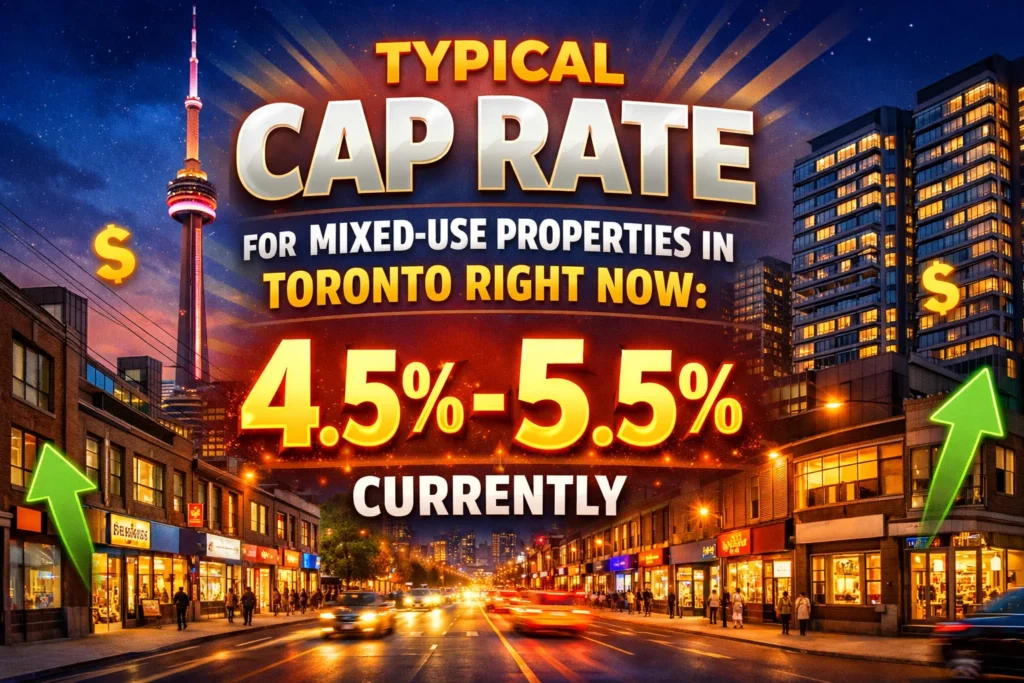
While the market is diverse, current 2026 benchmarks for premium assets are hovering between 5.0% and 5.5%. Understanding where your property sits within or outside this range is the key to accurate valuation and long-term ROI.
What is a Cap Rate and Why Does it Matter?
The Capitalization Rate (Cap Rate) is the ratio of Net Operating Income (NOI) to the property asset value. In simple terms, it indicates the expected rate of return on a real estate investment.
- Low Cap Rate (4% – 4.5%): Indicates high-demand, low-risk areas (like the Financial District or Yorkville) where capital appreciation is the primary goal.
- Higher Cap Rate (6% +): Often found in emerging submarkets where the risk is higher, but the immediate cash flow is greater.
Why 5.0% to 5.5% is the “Sweet Spot” in 2026
For premium mixed-use properties in Toronto, the 5.0% to 5.5% range reflects a “stabilized” market. Here is what is driving those numbers:
- Residential Resilience: The residential portion of mixed-use buildings continues to see record-low vacancies in the GTA, providing a “safety net” for the investment.
- The Retail Rebound: High-street retail (service-based businesses like clinics and boutique cafes) has proven more resilient than traditional big-box retail, supporting higher rents.
- Transit-Oriented Development: Properties located along the Ontario Line or near the Vaughan Metropolitan Centre (VMC) are commanding the tightest cap rates due to guaranteed future demand.
Factors That Can Compress or Expand Your Cap Rate
Not all mixed-use assets are created equal. When evaluating commercial real estate for lease in Ontario, consider these variables:
- The “ESG Premium”: As mentioned in our [ESG Compliance Guide], buildings with green certifications often see cap rate compression because they are cheaper to operate and attract higher-quality tenants.
- Tenant Mix: A building with a “Triple Net” (NNN) corporate tenant on the ground floor is viewed as lower risk than one with high-turnover local retail.
- Physical Condition: Older buildings facing the “Brown Discount” may have higher cap rates (6.5%+) to compensate for the significant capital expenditure (CapEx) required for modern upgrades.
Contact Allen Mayer for a Property Valuation
Determining the Cap Rate for mixed-use properties in Toronto requires more than just a calculator; it requires local market “intel” that algorithms can’t see. Allen Mayer leverages 25+ years of experience and a “Hybrid Specialist” approach to help you determine the true market value of your asset or your next acquisition.
Wondering what your property is worth in today’s market? Contact Allen Mayer for a confidential valuation and market analysis.
Read More :
- How to Calculate Cap Rate or Capitalization Rate
- Commercial Investment Property Toronto: Beyond Cap Rates and NOI — What 25 Years Taught Me About Real Value