
Why do Landlords Look for a 5 Year Lease? As a Minimum.
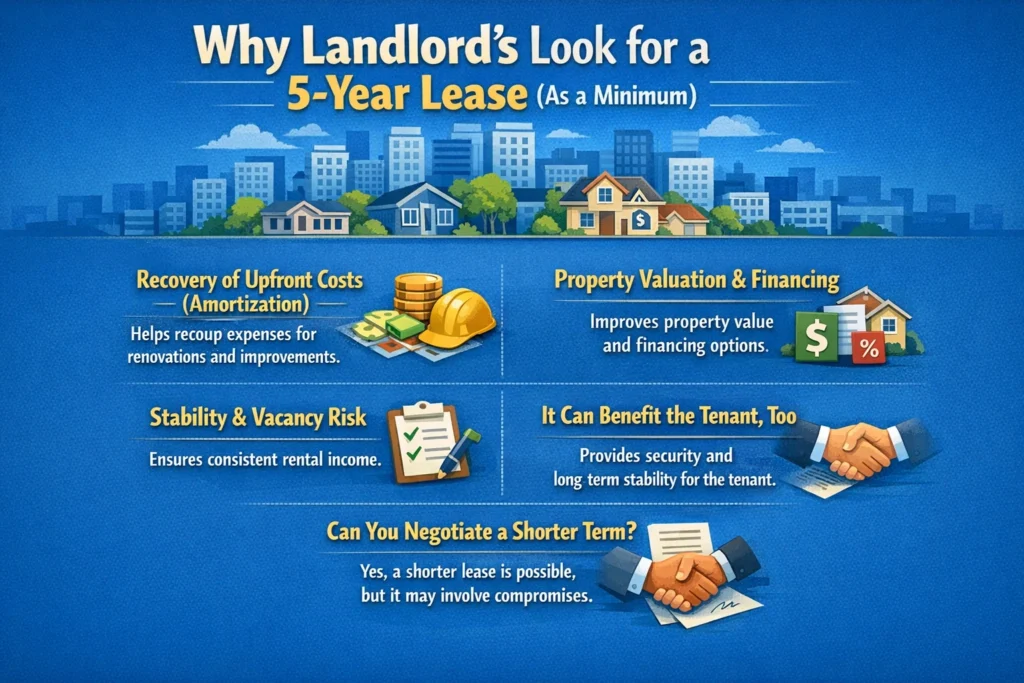
A five-year lease is the “gold standard” in commercial real estate, whereas residential leases usually run for only one year. This difference exists because office rentals operate on a completely different financial model.
Here is a breakdown of why landlords push for that 5-year commitment.
1. Recovery of Upfront Costs (Amortization)
This is the single biggest financial reason. When a landlord signs a new tenant, they often spend a significant amount of money upfront—long before they collect the first month’s rent. They need a 5-year term to earn that money back and turn a profit.
- Tenant Improvement (TI) Allowances: Landlords frequently provide an allowance to build out the space (walls, flooring, electrical) to fit your specific business needs. If they spend $50,000 renovating your office, they cannot recoup that investment in a 1 or 2-year lease.
- Broker Commissions: Landlords usually pay the real estate commissions for both their agent and your agent. This is calculated as a percentage of the total lease value and paid upfront.
The Math: If a landlord spends $20,000 on commissions and $30,000 on renovations to get you in the door, they are starting $50,000 in the hole. A 5-year term spreads this cost out, making the deal viable.
2. Property Valuation and Financing
Commercial buildings are valued differently than houses. A house is valued based on what similar houses sold for (comps). An office building is valued based on its income stream.
- Lender Requirements: Banks and lenders view short-term leases as “risky.” If a landlord wants to refinance their building or get a loan for repairs, the bank wants to see a “WALT” (Weighted Average Lease Term) that is long and stable.
- Asset Value: A building full of tenants with 5-year leases is worth significantly more to a potential buyer than a building full of tenants on month-to-month or 1-year deals.
3. Stability and Vacancy Risk
Turnover is the enemy of commercial real estate. When a residential tenant leaves, you paint the walls and find a new one in a month. When an office tenant leaves:
- The space may sit empty for 6–12 months.
- The layout might need to be completely demolished for the next user.
- Marketing costs are high.
A 5-year lease guarantees the landlord won’t have to face the expensive “vacancy cycle” for half a decade.
4. It Can Benefit the Tenant, Too
While it feels like a shackle, a 5-year lease offers you protection as well:
- Rent Certainty: You lock in your base rent. If the market explodes and rents double in two years (common in booming cities), your rent stays the same.
- Business Continuity: You don’t have to worry about being kicked out or having your lease non-renewed right as your business is hitting its stride.
Can you negotiate a shorter term?
Yes, but there is usually a trade-off. If you ask for a 3-year lease, the landlord will likely:
- Ask for a higher monthly rent per square foot (to hedge their risk).
- Refuse to pay for any renovations (you will have to lease the space “as-is”).
- Refuse to give any “free rent” periods.
With over 25 years in the Commercial Real Estate market, Allen Mayer specializes in bridging the gap between landlord requirements and tenant needs. Whether you are looking for office space in the downtown core or industrial units in the GTA, having an expert negotiator on your side is vital.
Negotiating a lease? Contact Allen Mayer today for strategic advisory services tailored to your business goals.